
HAKONE XIX Symposium in Canada with the Kogelschatz Lecture Award for Anne Bourdon
Article originally written for the ILTPC Newsletter
The 19th International Symposium on High Pressure Low Temperature Plasma Chemistry was held in Montréal, Canada, from August 23 to 27, 2026. The bi-annual symposium is known and established under its byname HAKONE, named after the first conference venue in Japan in 1987. The symposium was hosted in North-America for the first time.
HAKONE brings together scientists and engineers from academia and industry to connect more traditional subjects such as ozone synthesis, basic oxidants generation, water treatment and environmental protection to the emerging and innovative fields of biomedical applications, gas conversion, microplasmas and alternative materials. At HAKONE XIX 98 participants presented 6 invited talks, 50 contributed talks and 29 posters. The participants came from 12 countries, most from the hosting country (38). 36 participants were early career researchers (master or PhD students).
The first highlight of the symposium was the Kogelschatz award lecture given by Anne Bourdon (CNRS, École Polytechnique, Institut Polytechnique de Paris, Palaiseau, France). The Kogelschatz lecture award was created in memory of Ulrich Kogelschatz, one of the founders of the HAKONE symposium and chair of the international scientific committee. It is intended to honor the awardee for significant contributions to basic research on high pressure low temperature plasma chemistry and/or for the use of this knowledge in applications. The fourth award winner Anne Bourdon was honored for her outstanding contribution to the modelling of low-temperature plasmas, which has provided new insights into key aspects of their physics, particularly regarding the role of photoionisation processes. Her talk gave a profound and inspiring overview on the challenges and strategies for the simulation of nonthermal plasmas and on transient discharges and streamers in particular.
The invited talks were presented by Katharina Stapelmann (North Carolina State University, USA) on plasma endpoint detection for wound healing, Atsushi Komuro (AIST, Japan) on physicochemical dynamics of streamers in barrier discharges, Tom Huiskamp (TU Eindhoven, The Netherlands) on scalability of streamer discharge generation for industrial air purification, François Reniers (Université libre de Bruxelles, Belgium) on the deposition of thin films by barrier discharges, and Stephan Reuter (Polytechnique Montréal, Canada) on control and diagnostic-based tailoring of plasma reactivity in health, environment, and agriculture. These topics are excellent examples of the full range of contributions to the event.
Thanks to the generous support of 11 sponsors, participants with particularly outstanding contributions were recognized. The winners were selected either by a jury or through a vote among all participants. The award winners were:
- Agrien Gady (Université Paris Saclay) for the best oral presentation given by a student (1st place)
- Jisu Jeon (University of Michigan) for the best oral presentation given by a student (2nd place)
- Yiwei Jiang (McGill University, Laval University and CHU of Québec) for the best oral presentation given by postdoctoral researcher
- Mahdi Boussa (University de Montréal) for the best poster presentation by a student (1st place)
- Juliette Zveny (Université libre de Bruxelles) for the best poster presentation by a student (2nd place)
- Juliette Letellier-Bao (Polytechnique Montréal) & Levin Krös (INP Greifswald) with the people’s choice award for the best oral presentation by a student (2 winners)
- Roxane Thomas (Polytechnique Montréal) with people’s choice award for the best poster presentation by a student
Photos by Louis-Charles Fortier
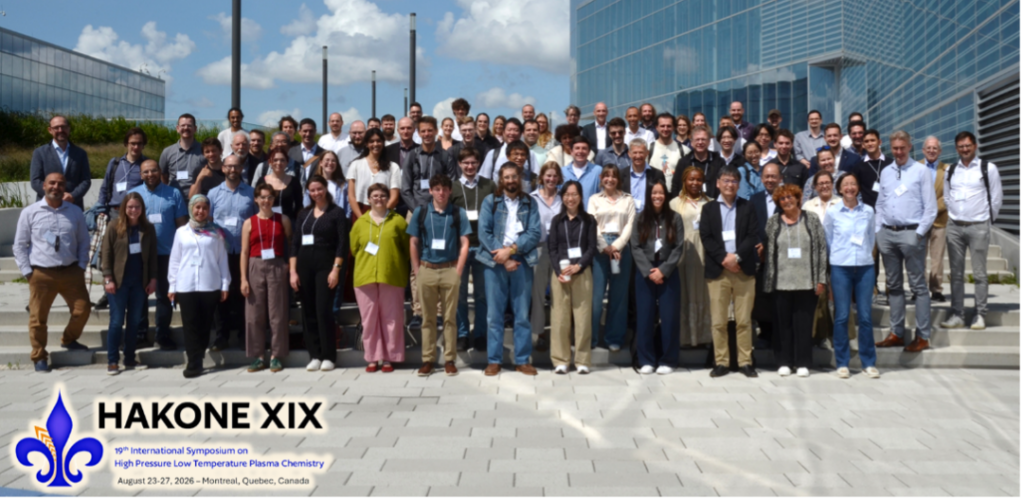
HAKONE XIX group photo at the Complexe des Sciences of Université de Montréal (Campus MIL)
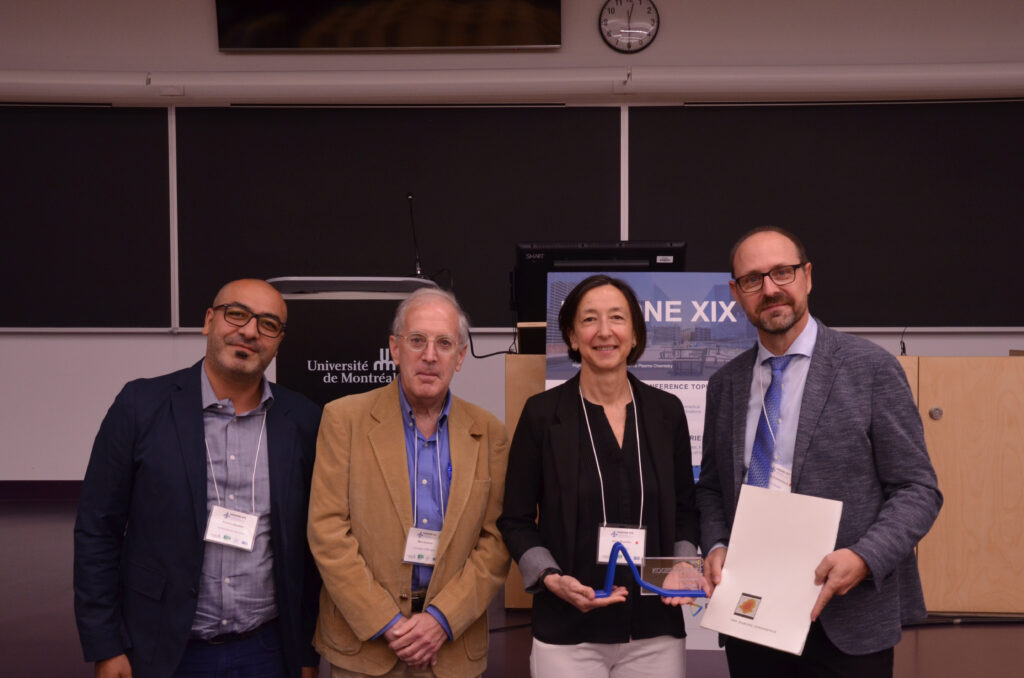
Anne Bourdon (third left) with the Kogelschatz award and the LOC chairs Ahmad Hamdan,
Mark J. Kushner and ISC chair Ronny Brandenburg
The entire symposium was once again characterized by an informal atmosphere, which enabled the participants to engage in a close and concentrated scientific and personal exchange. The participants enjoyed the venue as well as the social events with the banquet The entire International Scientific Committee and all participants express their deepest gratitude to Ahmad Hamdan and Mark Kushner and all colleagues from Université de Montréal, University of Michigan, Université du Québec and McGill University for the prefect organization as well as all sponsors for their generous support.
The upcoming symposium HAKONE XX will be the 20th edition and will also celebrate its 40th anniversary. We are therefore especially pleased that the upcoming symposium will once again take place in Japan, where it all began. In 2028, the community will meet in Kanazawa. Interested parties and friends can stay up to date via the symposium’s website www.hakone-symposium.org.
Prof. Dr. Ronny Brandenburg, Chair, International Science Committee
Prof. Ahmad Hamdan, Chair, Local Organizing Committee
Prof. Mark J. Kushner, Co-Chair, Local Organizing Committee